
Technical Properties of Travertine: Hardness, Durability, and Applications
Your trusted partner for delivering premium natural stones to global markets with excellence and reliability!
Technical Properties of Travertine: Hardness, Durability, and Applications
Technical Properties of Travertine: Hardness, Durability, and Applications
Among natural stones, travertine stands out in the European market thanks to its technical properties as well as its aesthetic appeal. Its porous texture, workability, durability, and surface treatment options make it suitable for both interior and exterior applications.
 Hardness Level of Travertine
Travertine’s hardness ranges between 3–4 on the Mohs scale, making it softer than marble but easier to process.
-
Light Mix Travertine is preferred in Italy and France for decorative projects due to its easy cutting and workability.
-
Standard Mix Travertine is popular in Romania and Poland for large-scale projects requiring strength.
Durability Features
Travertine’s durability increases with surface treatments such as polishing, honing, and brushing.
-
Walnut Travertine, with proper finishing, can last 30–40 years in luxury housing projects in UK and Switzerland.
-
Silver Travertine is widely used in Germany, Austria, and Scandinavia for exterior applications due to its resilience.
Applications of Travertine
Travertine’s technical features make it a versatile material:
-
Interiors → Floors, walls, staircases, bathrooms, kitchen countertops.
-
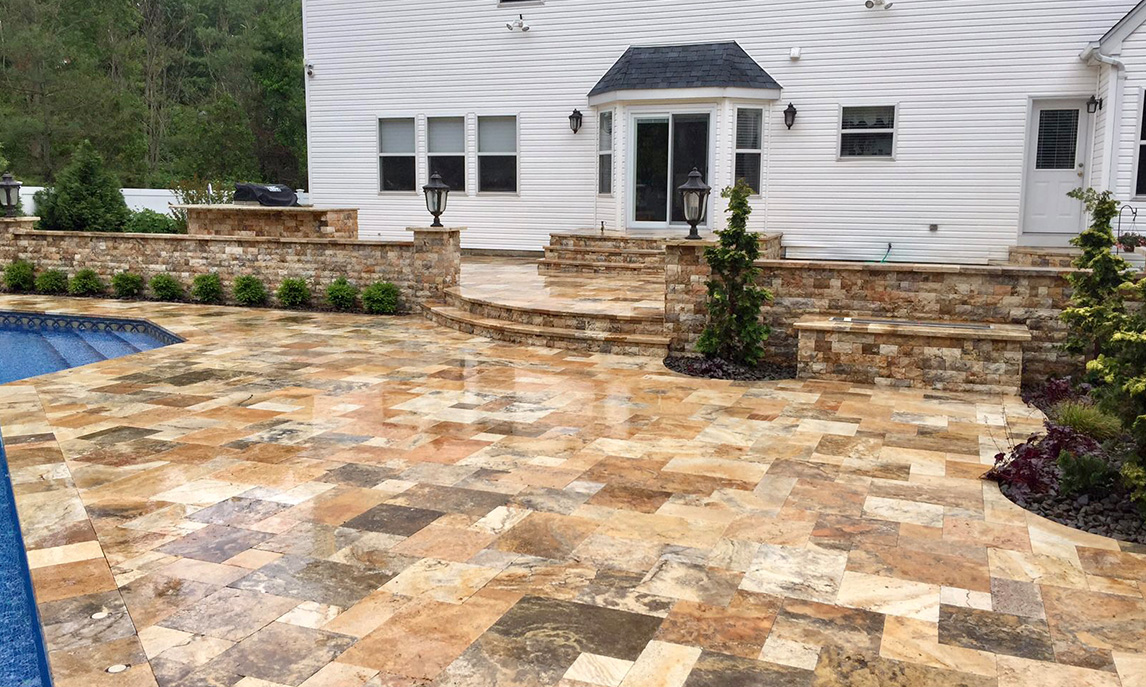
Exteriors → Facades, garden pathways, pool surrounds, hotel projects.
-
Public spaces → Shopping centers, offices, hotels.
For instance, Light Mix Travertine brings brightness to interiors, while Silver Travertine is ideal for modern facades.
Country-Specific Preferences in Europe
-
Germany & Austria → Silver Travertine and Standard Mix Travertine dominate exterior projects due to durability.
-
Italy & France → Light Mix Travertine is favored for its bright tones and aesthetic appeal.
-
UK & Switzerland → Walnut Travertine is used in luxury housing for its warm, rustic look.
-
Romania & Poland → Standard Mix Travertine is chosen for affordable and durable housing projects.
-
Scandinavia → Silver Travertine is the most demanded option for exteriors in harsh weather.
Conclusion
With its hardness, durability, and wide range of applications, travertine has become an essential natural stone in the European market. Light Mix, Standard Mix, Walnut, and Silver Travertine varieties provide tailored solutions to meet the technical requirements of each country.